Understanding Moral OCD: When Good Intentions Become Overwhelming
Have you ever had a thought pop into your head that made you feel like a terrible person? Maybe you worried that you accidentally said something hurtful, or you kept replaying a moment to check if you did the right thing. For most people, these thoughts come and go. But for someone with Moral OCD, also called scrupulosity, these worries become a constant, exhausting battle.
Moral OCD is a type of Obsessive-Compulsive Disorder where your brain gets stuck on questions about right and wrong, good and bad. It’s like having a very loud, very anxious judge living in your mind, constantly questioning whether you’re a good person. This isn’t about actually being immoral—in fact, people with Moral OCD are often the kindest, most ethical people you’ll meet. The problem is that their brain won’t let them believe it.
If you’ve been struggling with constant guilt, fear of being a bad person, or spending hours trying to prove to yourself that you’re moral, you’re not alone. Research shows that about 25-30% of people with OCD experience scrupulosity as their primary symptom (Abramowitz et al., 2002). Understanding this condition is the first step toward getting the help you need.
 Person finding peace from moral OCD through meditation
What Exactly Is Moral OCD?
Moral OCD, or scrupulosity, is a subtype of Obsessive-Compulsive Disorder that focuses on ethical, moral, and religious concerns. While regular OCD might involve fears about germs or checking locks, Moral OCD makes people obsess over whether they’re a good person, whether they’ve done something wrong, or whether they might hurt someone (even when there’s no evidence they have).
The Australian Psychological Society recognises OCD as a serious mental health condition that affects about 2-3% of Australians at some point in their lives (APS, 2023). Moral OCD is one of the most distressing forms because it attacks the very core of who you are—your values and identity.
The Two Main Components of Moral OCD
Like all forms of OCD, Moral OCD has two main parts:
1. Obsessions (the unwanted thoughts) These are intrusive thoughts, images, or urges that create intense anxiety. In Moral OCD, these might include:
- Constant worry that you’ve hurt someone’s feelings
- Fear that you’re secretly a bad person
- Intrusive thoughts about doing something immoral
- Excessive concern about lying, even about tiny things
- Worrying that you’ve broken religious or ethical rules
- Fear of being judged as immoral by others or by a higher power
2. Compulsions (the behaviours you do to feel better) These are repetitive actions or mental acts you perform to reduce the anxiety from obsessions:
- Confessing repeatedly to things you might have done wrong
- Asking others for reassurance that you’re a good person
- Mentally reviewing past actions to check if you did something bad
- Avoiding situations where you might make a moral mistake
- Praying excessively or performing rituals to “undo” bad thoughts
- Reading religious or ethical texts repeatedly for reassurance
The cruel trick of OCD is that these compulsions only provide temporary relief. Soon, the doubt comes back stronger, and you need to perform the compulsion again. It becomes an exhausting cycle.
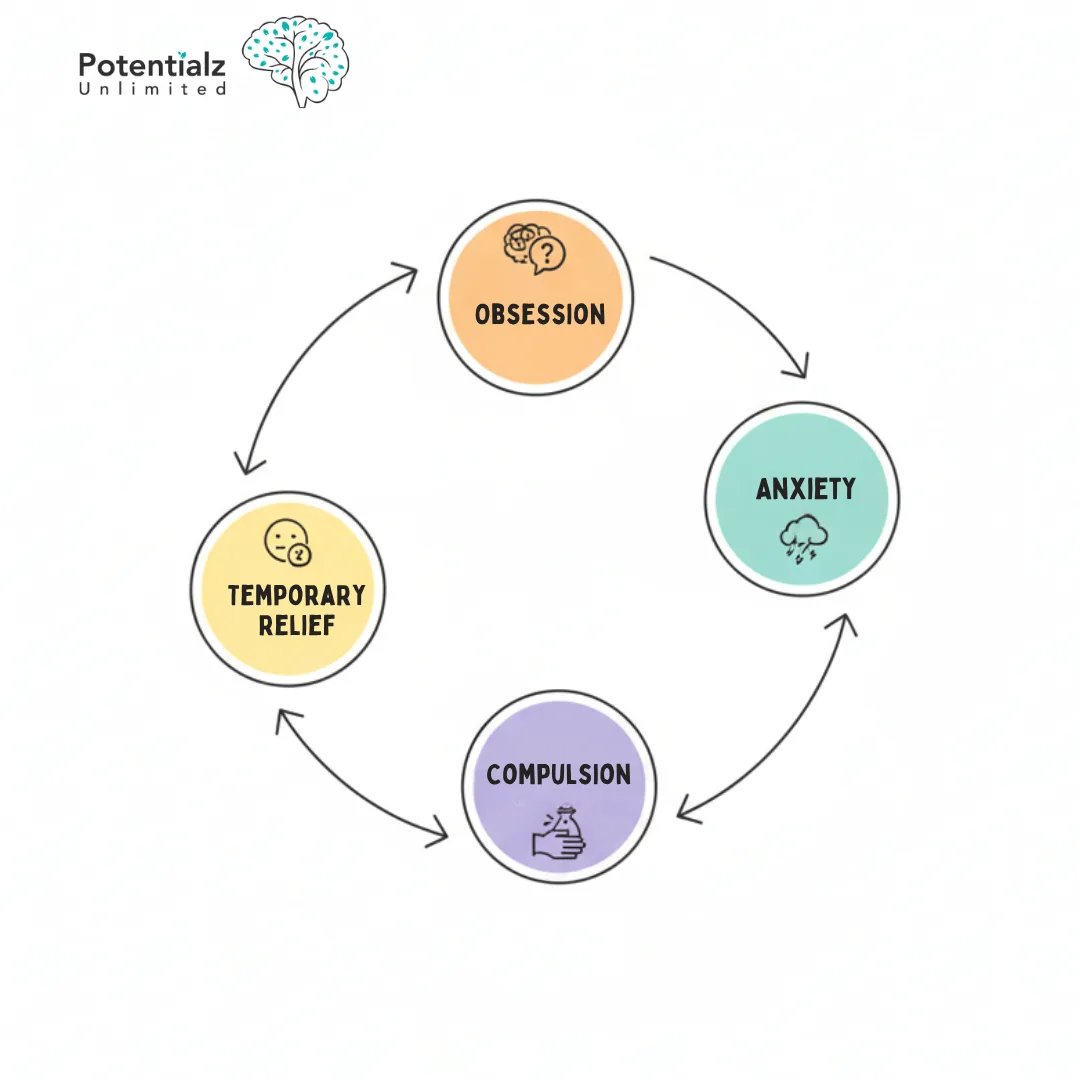 Cycle of Obsessive-Compulsive Disorder: The diagram illustrates the persistent cycle of OCD, starting with obsessions that lead to anxiety, followed by compulsions, and ending with temporary relief before the cycle repeats.
Common Types of Moral OCD Thoughts
Moral OCD can show up in many different ways. Here are some common patterns that people experience:
Religious Scrupulosity
This involves excessive concern about religious rules and fear of sinning. You might:
- Worry constantly about blasphemous thoughts
- Fear you’re not praying “correctly”
- Doubt whether you’ve properly followed religious teachings
- Worry excessively about your spiritual standing
Ethical Perfectionism
This focuses on secular morality and being a “good person.” You might:
- Replay conversations constantly to check if you said anything hurtful
- Worry excessively about fairness in every decision
- Fear accidentally lying or being dishonest
- Feel intense guilt over small mistakes that most people would forget
Harm-Related Moral Obsessions
These involve fear of causing harm to others. You might:
- Worry that you accidentally hurt someone without realising it
- Fear you might have caused someone emotional pain
- Check repeatedly whether your actions might have negative consequences
- Avoid people or situations for fear of causing harm
Responsibility OCD
This involves excessive concern about being responsible for bad outcomes. You might:
- Feel personally responsible for preventing bad things from happening
- Worry that not doing something perfectly might cause harm
- Feel like you need to confess to mistakes to prevent future problems
The Science Behind Moral OCD
Understanding what’s happening in your brain can help you realise that Moral OCD isn’t your fault—it’s a neurobiological condition that can be treated.
Research using brain imaging has shown that people with OCD have different patterns of brain activity, particularly in areas involved in decision-making, error detection, and regulating emotions (Pauls et al., 2014). The orbitofrontal cortex (which helps with decision-making), the anterior cingulate cortex (which detects errors), and the striatum (involved in habits) all show unusual patterns in people with OCD.
Think of it like having an overactive alarm system in your brain. For someone without OCD, the brain recognises that “I might have said something wrong” is a small concern and moves on. For someone with Moral OCD, the alarm keeps ringing loudly, insisting that this is a major emergency that needs immediate attention.
Studies have also shown that people with Moral OCD often have an “inflated sense of responsibility”—they believe they have more power to cause or prevent harm than they actually do (Salkovskis et al., 2000). This isn’t a character flaw; it’s a cognitive pattern that can be changed with proper treatment.
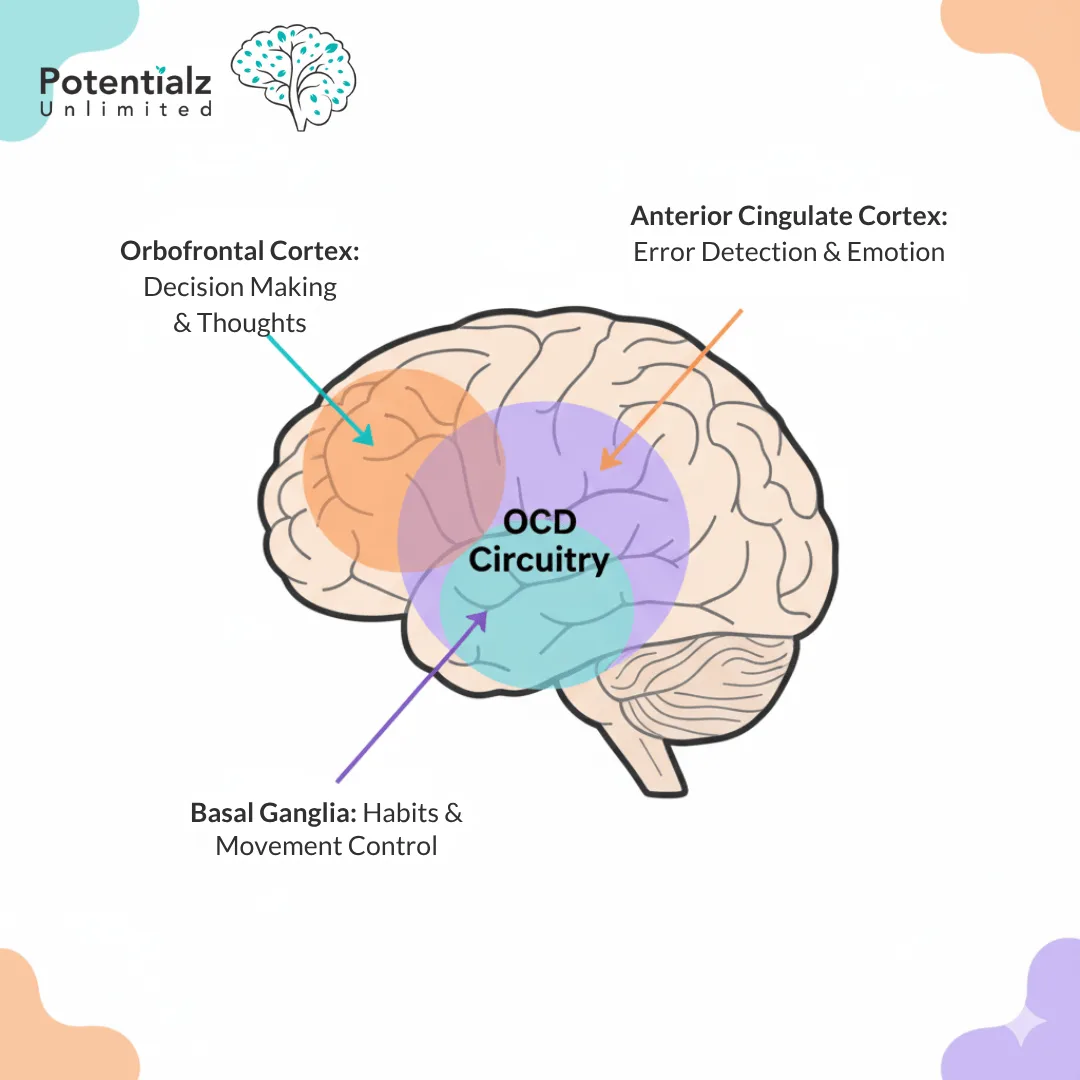 Diagram illustrating the brain circuitry involved in OCD, highlighting the roles of the orbitofrontal cortex in decision making, the anterior cingulate cortex in error detection and emotion, and the basal ganglia in habits and movement control.
How Moral OCD Affects Daily Life
Living with Moral OCD can feel like carrying a heavy weight everywhere you go. Here’s how it might impact different areas of your life:
Relationships
- Constantly seeking reassurance from partners, friends, or family
- Confessing repeatedly, which can strain relationships
- Avoiding social situations for fear of making a mistake
- Difficulty trusting that others forgive you
Work or School
- Taking much longer to complete tasks because you’re checking for mistakes
- Difficulty making decisions for fear of making the wrong choice
- Excessive apologising to colleagues or teachers
- Productivity suffers due to time spent on compulsions
Mental Health
- Constant anxiety and guilt
- Depression from feeling like a “bad person”
- Exhaustion from fighting intrusive thoughts all day
- Low self-esteem despite being highly moral
Daily Activities
- Simple tasks take much longer due to moral checking
- Avoiding activities that might trigger moral concerns
- Spending hours reviewing past events mentally
- Difficulty enjoying life due to constant worry
The good news is that with proper treatment, people with Moral OCD can significantly reduce these symptoms and reclaim their lives.
Evidence-Based Treatment for Moral OCD
The most effective treatment for Moral OCD combines two approaches: Exposure and Response Prevention (ERP) therapy and Cognitive Behavioural Therapy (CBT). Research consistently shows that these treatments can help 60-80% of people with OCD experience significant improvement (Öst et al., 2015).
Exposure and Response Prevention (ERP)
ERP is considered the gold standard treatment for OCD. It works by gradually exposing you to situations that trigger your moral obsessions, while helping you resist performing compulsions.
Here’s how it works:
- Creating an exposure hierarchy: You and your psychologist create a list of situations that trigger your Moral OCD, ranked from least to most anxiety-provoking.
- Gradual exposure: You start with easier situations and gradually work up to more difficult ones. For example, if you have religious scrupulosity, you might start by delaying a prayer ritual by a few minutes, then work up to reducing repetitive prayers.
- Response prevention: The crucial part—you resist performing the compulsion. Your psychologist helps you sit with the anxiety without seeking reassurance, confessing, or mentally reviewing.
- Learning: Over time, your brain learns that the feared outcome doesn’t happen, and that you can tolerate the anxiety. The obsessions become less powerful.
At our practice in Bella Vista, our psychologists are highly trained in OCD treatment and work closely with clients to ensure ERP is done at a pace that feels manageable.
Cognitive Behavioural Therapy (CBT)
CBT helps you identify and change the thought patterns that maintain your Moral OCD. An experienced CBT psychologist will help you:
- Recognise cognitive distortions like “thought-action fusion” (believing that having a bad thought is the same as acting on it)
- Challenge inflated responsibility beliefs
- Develop more balanced ways of thinking about morality
- Reduce self-criticism and perfectionism
- Build self-compassion
Acceptance and Commitment Therapy (ACT)
Some psychologists also use ACT alongside ERP and CBT. ACT helps you accept intrusive thoughts without struggling against them, while focusing on living according to your values rather than trying to control every thought.
Medication
While therapy is the first-line treatment, some people benefit from medication, particularly Selective Serotonin Reuptake Inhibitors (SSRIs). These can help reduce the intensity of obsessions, making it easier to engage with therapy. An experienced clinical psychologist can work with your GP or psychiatrist to coordinate care if medication is appropriate.
 A therapist and patient engage in a focused discussion during an OCD therapy session, set in a comfortable and serene environment.
Practical Strategies for Managing Moral OCD
While professional treatment is essential, here are some strategies you can start using today:
1. Name the OCD
When you have a moral obsession, try saying to yourself: “This is my OCD talking, not my values.” This creates distance between you and the thought.
2. Delay Compulsions
Instead of immediately seeking reassurance or confessing, try waiting 5 minutes. Then 10. Then 15. This builds your tolerance for uncertainty.
3. Set Limits on Checking and Confessing
If you typically confess the same thing multiple times, try limiting yourself to once. If you mentally review past events for hours, set a timer for 5 minutes only.
4. Practice Uncertainty Tolerance
OCD hates uncertainty. Try saying phrases like “Maybe I did, maybe I didn’t” or “I can live with not knowing for sure.” This is uncomfortable at first but gets easier.
5. Use Mindfulness
Apps like Smiling Mind (created by Australian psychologists) can help you practice observing thoughts without judging them or acting on them.
6. Build a Support Network
Connect with others who understand OCD. The mental health challenges we face feel less isolating when we share them with others.
7. Focus on Values-Based Living
Instead of trying to be “perfect,” focus on living according to your genuine values. If kindness is important to you, practice small acts of kindness rather than obsessing over whether you’re kind enough.
When to Seek Professional Help
You should consider seeing an OCD psychologist in Bella Vista if:
- Your moral obsessions take up more than an hour per day
- Compulsions interfere with work, school, or relationships
- You’re avoiding situations due to fear of moral failure
- You’re experiencing depression or anxiety alongside OCD
- Self-help strategies aren’t providing relief
- Your quality of life is significantly impacted
At Potentialz Psychology Practice, our team includes psychologists with specialised training in OCD treatment. We understand that Moral OCD is not about lacking morals—it’s about having a brain that’s working overtime to keep you “safe” from moral mistakes.
Moral OCD in Young People
Moral OCD often starts in adolescence or early adulthood, which is when many people are developing their sense of identity and values. For young people aged 15-25, Moral OCD can be particularly distressing because you’re already navigating questions about who you are and what you believe.
If you’re a young person with Moral OCD, know that:
- You’re not alone—many teenagers and young adults experience this
- It’s not your fault, and it doesn’t mean you’re a bad person
- Treatment works well for young people
- Early intervention can prevent OCD from getting worse
Parents of young people with possible Moral OCD should look for signs like excessive apologising, constant requests for reassurance, extreme guilt over minor issues, or avoidance of normal activities due to moral fears. Our child psychologists in Bella Vista can provide age-appropriate assessment and treatment.
 A group of young individuals, smiling and embracing positivity, symbolizing their journey towards overcoming moral OCD symptoms.
The Difference Between Moral OCD and Being Conscientious
It’s important to distinguish between Moral OCD and simply being a conscientious person. Here’s the difference:
Being Conscientious:
- You care about doing the right thing
- You think about ethical issues and try to make good choices
- You feel appropriate guilt when you actually do something wrong
- You can forgive yourself and move forward
- Your moral concerns don’t interfere with daily functioning
Moral OCD:
- You’re tormented by constant doubt about whether you’re good enough
- You can’t trust your own judgment about right and wrong
- You feel intense guilt over minor or imaginary offenses
- You can’t forgive yourself, even when others have forgiven you
- Your moral concerns significantly interfere with daily life
Having high moral standards is wonderful. Having Moral OCD means your brain is misinterpreting normal moral concerns as emergencies that need constant attention.
Recovery Is Possible
One of the most important things to understand about Moral OCD is that recovery is absolutely possible. You don’t have to live with constant guilt and anxiety forever.
Research shows that with proper treatment, most people with OCD experience significant improvement. In fact, studies of ERP therapy show that about 60-80% of people who complete treatment have much better quality of life, with reduced symptoms that no longer interfere with daily activities (Öst et al., 2015).
Recovery doesn’t necessarily mean never having another intrusive thought—that’s unrealistic for anyone. Instead, it means:
- The thoughts have less power over you
- You can recognise them as “just thoughts” rather than facts
- You spend much less time on compulsions
- You can live according to your values without constant doubt
- Your relationships improve
- You have more energy for things you enjoy
At Potentialz Psychology Practice, we’ve helped many people in Bella Vista and surrounding areas like Norwest, Castle Hill, and Baulkham Hills find relief from Moral OCD. We understand the unique challenges of this condition and provide evidence-based, compassionate care tailored to your specific needs.
Building a Stronger Foundation: Additional Support
While working on your Moral OCD with an OCD specialist, you might also benefit from addressing related issues:
Anxiety Management
Many people with OCD also experience generalised anxiety. Our anxiety psychologists can help you develop broader anxiety management skills.
Trauma Work
Sometimes Moral OCD develops after a traumatic event or in response to strict upbringing. EMDR therapy or trauma-focused treatment might be helpful alongside OCD treatment.
Family Support
OCD affects the whole family. Family therapy can help your loved ones understand how to support you without enabling compulsions.
Building Emotional Skills
DBT (Dialectical Behaviour Therapy) can help you develop skills for managing intense emotions that often accompany OCD.
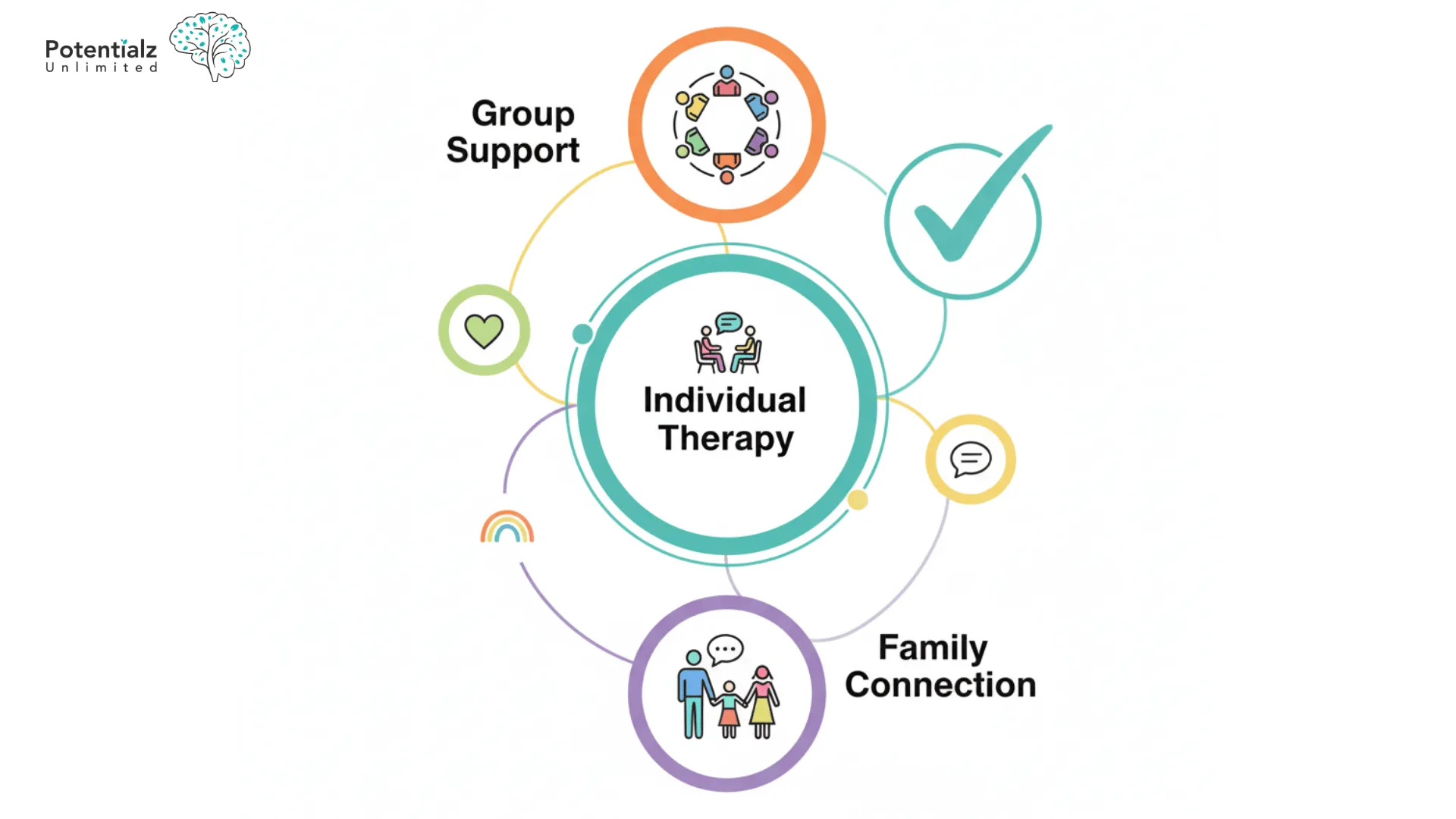 Comprehensive psychology services for OCD treatment
Your Next Steps
If you recognise yourself in this article, here’s what you can do:
- Take the quiz below to assess whether you might have Moral OCD
- Schedule an assessment with an OCD psychologist
- Talk to someone you trust about what you’re experiencing
- Learn more about OCD through reliable sources
- Be patient with yourself as you begin this journey
Remember, seeking help is a sign of strength, not weakness. Living with Moral OCD is exhausting, and you deserve support.
Book Your Appointment Today
At Potentialz Psychology Practice in Bella Vista, we offer comprehensive psychology services including APS approved OCD treatment. Our experienced team, led by Dr Gurprit Ganda (Clinical Psychologist with 22 years of experience), provides evidence-based treatment in a warm, non-judgmental environment.
We’re conveniently located in Bella Vista and serve the surrounding areas including Norwest, Castle Hill, Kellyville, Baulkham Hills, and Rouse Hill.
Contact us today to book your initial consultation. We offer Medicare rebates and NDIS services for eligible clients.
Test Your Knowledge
References (APA 7th Edition)
- Abramowitz, J. S., Huppert, J. D., Cohen, A. B., Tolin, D. F., & Cahill, S. P. (2002). Religious obsessions and compulsions in a non-clinical sample: The Penn Inventory of Scrupulosity (PIOS). Behaviour Research and Therapy, 40(7), 825-838. https://doi.org/10.1016/S0005-7967(01)00070-5
- Australian Psychological Society. (2023). Obsessive-compulsive disorder. https://psychology.org.au
- Öst, L. G., Havnen, A., Hansen, B., & Kvale, G. (2015). Cognitive behavioral treatments of obsessive-compulsive disorder: A systematic review and meta-analysis of studies published 1993-2014. Clinical Psychology Review, 40, 156-169. https://doi.org/10.1016/j.cpr.2015.06.003
- Pauls, D. L., Abramovitch, A., Rauch, S. L., & Geller, D. A. (2014). Obsessive-compulsive disorder: An integrative genetic and neurobiological perspective. Nature Reviews Neuroscience, 15(6), 410-424. https://doi.org/10.1038/nrn3746
- Salkovskis, P. M., Wroe, A. L., Gledhill, A., Morrison, N., Forrester, E., Richards, C., Reynolds, M., & Thorpe, S. (2000). Responsibility attitudes and interpretations are characteristic of obsessive compulsive disorder. Behaviour Research and Therapy, 38(4), 347-372. https://doi.org/10.1016/S0005-7967(99)00071-6
Need Professional Support?
If you're experiencing mental health concerns, our team is here to help.